> ## Documentation Index
> Fetch the complete documentation index at: https://docs.zespan.com/llms.txt
> Use this file to discover all available pages before exploring further.
# Google ADK
> Trace Google Agent Development Kit (ADK) agents and multi-agent systems using instrumentADK, wrapADKRunner, and wrapADKAgent in TypeScript and Python.
Available for: **Python** and **TypeScript**.
Zespan provides first-class tracing for Google's Agent Development Kit (ADK). Every model call, tool invocation, and agent-to-agent delegation in your ADK workflow is captured as a linked span — without modifying your agent definitions.
## TypeScript
### Installation
```bash theme={"theme":{"light":"github-light","dark":"one-dark-pro"}}
npm install @zespan/sdk @google/adk
```
### Four integration patterns
Choose the integration pattern that fits your setup:
| Pattern | Use when |
| -------------------------- | -------------------------------------------------- |
| `instrumentADK` | Production apps — wraps agent + runner in one call |
| `wrapADKRunner` | You manage the runner lifecycle separately |
| `ZespanADKCallbackHandler` | Native ADK callbacks — wire into `LlmAgent` config |
| `wrapADKAgent` | Tests and scripts — direct agent wrapping |
***
### `instrumentADK` — recommended for production
`instrumentADK` wraps both your coordinator agent and its runner in a single call. Use this when building production ADK applications.
```typescript theme={"theme":{"light":"github-light","dark":"one-dark-pro"}}
import { zespan, instrumentADK } from "@zespan/sdk";
import { Agent, InMemoryRunner } from "@google/adk";
zespan.init({ apiKey: process.env.ZESPAN_API_KEY! });
// Your normal ADK setup
const policyAgent = new Agent({
model: "gemini-2.5-flash",
name: "PolicyAgent",
instructions: "Check refund policies and eligibility.",
});
const orderAgent = new Agent({
model: "gemini-2.5-flash",
name: "OrderAgent",
instructions: "Look up order details by order ID.",
});
const coordinator = new Agent({
model: "gemini-2.5-pro",
name: "SupportCoordinator",
subAgents: [policyAgent, orderAgent],
instructions: "Route customer requests to the right specialist.",
});
const runner = new InMemoryRunner({ agent: coordinator });
// Wrap both at once — returns instrumented versions
const { coordinator: tracedCoordinator, runner: tracedRunner } = instrumentADK({
coordinator,
runner,
agentName: "SupportCoordinator",
agentRole: "coordinator",
sessionId: req.sessionId,
});
// Use tracedRunner exactly as you would the original runner
for await (const event of tracedRunner.runEphemeral({ userId: "u1", newMessage })) {
// handle ADK events
}
```
***
### `wrapADKRunner` — runner-level wrapping
Wraps `InMemoryRunner.runEphemeral()` and `Runner.run()` by intercepting the ADK event stream. Emits one span per agent author turn, one span per tool call, and handoff spans on delegation.
```typescript theme={"theme":{"light":"github-light","dark":"one-dark-pro"}}
import { zespan, wrapADKRunner } from "@zespan/sdk";
import { InMemoryRunner } from "@google/adk";
zespan.init({ apiKey: process.env.ZESPAN_API_KEY! });
const runner = wrapADKRunner(
new InMemoryRunner({ agent: coordinator }),
{
agentName: "SupportCoordinator",
agentRole: "coordinator",
model: "gemini-2.5-pro",
sessionId: req.session.id,
}
);
for await (const event of runner.runEphemeral({ userId: "u1", newMessage })) {
if (event.content) {
console.log(event.content.parts[0].text);
}
}
```
**`wrapADKRunner` options:**
Display name for the root agent span in Zespan.
Role hint for the agent registry. Use `"coordinator"` for orchestrators and `"specialist"` for sub-agents.
The model name used by the root agent. Shown in the trace detail panel.
Associates all spans from this run with a session in the Sessions view.
***
### `ZespanADKCallbackHandler` — native ADK callbacks
Uses ADK's built-in callback system (`beforeAgentCallback`, `afterModelCallback`, etc.). Create one handler instance and spread `.callbacks` into your `LlmAgent` config. Captures agent spans, LLM spans with full token counts, and tool call spans.
```typescript theme={"theme":{"light":"github-light","dark":"one-dark-pro"}}
import { zespan, ZespanADKCallbackHandler } from "@zespan/sdk";
import { LlmAgent, InMemoryRunner, RunConfig } from "@google/adk";
zespan.init({ apiKey: process.env.ZESPAN_API_KEY! });
const tracer = new ZespanADKCallbackHandler();
const agent = new LlmAgent({
name: "SupportAgent",
model: "gemini-2.5-flash",
instruction: "Help customers with order questions.",
tools: [lookupOrder],
...tracer.callbacks, // wires all 6 callbacks
});
const runner = new InMemoryRunner({ agent });
for await (const event of runner.runEphemeral({ userId: "u1", newMessage })) {
// handle events
}
```
For multi-agent systems, use the **same handler instance** across all agents so spans share the same trace:
```typescript theme={"theme":{"light":"github-light","dark":"one-dark-pro"}}
const tracer = new ZespanADKCallbackHandler();
const policyAgent = new LlmAgent({
name: "PolicyAgent",
model: "gemini-2.5-flash",
...tracer.callbacks,
});
const coordinator = new LlmAgent({
name: "Coordinator",
model: "gemini-2.5-pro",
subAgents: [policyAgent],
...tracer.callbacks,
});
```
`ZespanADKCallbackHandler` is also exported as `ADKCallbackHandler` for shorter imports:
```typescript theme={"theme":{"light":"github-light","dark":"one-dark-pro"}}
import { ADKCallbackHandler } from "@zespan/sdk";
```
***
### `wrapADKAgent` — agent-level wrapping
Wraps `agent.run()` directly. Best for unit tests and simple scripts. Recursively wraps `subAgents` by default.
```typescript theme={"theme":{"light":"github-light","dark":"one-dark-pro"}}
import { zespan, wrapADKAgent } from "@zespan/sdk";
zespan.init({ apiKey: process.env.ZESPAN_API_KEY! });
const tracedAgent = wrapADKAgent(coordinator, {
agentName: "SupportCoordinator",
agentRole: "coordinator",
traceSubAgents: true, // wrap all subAgents recursively
});
const result = await tracedAgent.run("I need a refund for order #123");
```
***
### What gets captured
All three wrappers capture the same data from the ADK event stream:
| ADK event | Zespan span |
| -------------------- | ----------------------------------------------------------------- |
| Agent turn start/end | `span_kind: "agent"` with latency, model, token counts |
| Tool call | `span_kind: "tool"` with tool name, args, result |
| Sub-agent delegation | `span_kind: "handoff"` with target agent name |
| Model response | Token counts (including cached + reasoning tokens), finish reason |
***
## Python
### Installation
```bash theme={"theme":{"light":"github-light","dark":"one-dark-pro"}}
pip install zespan google-adk
```
### Three integration patterns
| Pattern | Use when |
| -------------------------- | ------------------------------------------------------- |
| `ZespanADKCallbackHandler` | Native ADK callbacks — wire into `LlmAgent` constructor |
| `ZespanADKTracer` | Class-based — attach to an existing agent instance |
| `wrap_adk_agent` | Functional — wrap and return the agent in one call |
***
### `ZespanADKCallbackHandler` — native ADK callbacks
Uses ADK's built-in callback system. Create one handler and spread `.callbacks` into each `LlmAgent` constructor. Captures agent spans, LLM spans with full token counts, and tool spans.
ADK Python is async — run agents with `InMemoryRunner` inside `asyncio.run()`.
**Single agent:**
```python theme={"theme":{"light":"github-light","dark":"one-dark-pro"}}
import asyncio
import zespan
from google.adk.agents import LlmAgent
from google.adk.runners import InMemoryRunner
from google.genai.types import Content, Part
from zespan import ZespanADKCallbackHandler
zespan.init(api_key="zsp_your_api_key_here")
def lookup_order(order_id: str) -> dict:
"""Look up an order by ID to get status and delivery details."""
return {"orderId": order_id, "status": "delivered", "total": 49.99}
handler = ZespanADKCallbackHandler()
agent = LlmAgent(
name="SupportAgent",
model="gemini-2.5-flash",
instruction="Help customers with order questions.",
tools=[lookup_order],
**handler.callbacks, # wires all 6 callbacks
)
async def run(message: str) -> str:
runner = InMemoryRunner(agent=agent, app_name="my-app")
session = await runner.session_service.create_session(
app_name="my-app", user_id="user-123",
)
new_message = Content(role="user", parts=[Part(text=message)])
response = ""
async for event in runner.run_async(
user_id="user-123",
session_id=session.id,
new_message=new_message,
):
if event.is_final_response() and event.content:
response = "".join(p.text for p in event.content.parts if getattr(p, "text", ""))
return response
result = asyncio.run(run("What is the status of order #ORD-123?"))
print(result)
```
**Multi-agent system:**
Use the **same handler instance** across all agents — ADK shares the same `invocation_id` across coordinator and sub-agents, so all spans are automatically linked under one trace.
```python theme={"theme":{"light":"github-light","dark":"one-dark-pro"}}
import asyncio
import zespan
from google.adk.agents import LlmAgent
from google.adk.runners import InMemoryRunner
from google.genai.types import Content, Part
from zespan import ZespanADKCallbackHandler
zespan.init(api_key="zsp_your_api_key_here")
def lookup_order(order_id: str) -> dict:
"""Look up an order by ID."""
return {"orderId": order_id, "status": "delivered", "total": 49.99}
def process_refund(order_id: str, reason: str) -> dict:
"""Process a refund for an order."""
return {"success": True, "refundId": f"ref_{order_id}", "eta": "3-5 business days"}
# One handler for the entire agent system
handler = ZespanADKCallbackHandler()
order_agent = LlmAgent(
name="OrderAgent",
model="gemini-2.5-flash",
description="Handles order lookups.",
instruction="Look up order details and answer questions about order status.",
tools=[lookup_order],
**handler.callbacks,
)
refund_agent = LlmAgent(
name="RefundAgent",
model="gemini-2.5-flash",
description="Handles refund requests.",
instruction="Process refund requests. Always look up the order first.",
tools=[lookup_order, process_refund],
**handler.callbacks,
)
coordinator = LlmAgent(
name="SupportCoordinator",
model="gemini-2.5-flash",
description="Routes customer support requests.",
instruction=(
"Route requests to the correct specialist:\n"
"- OrderAgent: order status, tracking\n"
"- RefundAgent: refunds, returns\n"
"Always delegate — do not answer directly."
),
sub_agents=[order_agent, refund_agent],
**handler.callbacks,
)
async def run(message: str, user_id: str) -> str:
runner = InMemoryRunner(agent=coordinator, app_name="support")
session = await runner.session_service.create_session(
app_name="support", user_id=user_id,
)
new_message = Content(role="user", parts=[Part(text=message)])
response = ""
async for event in runner.run_async(
user_id=user_id,
session_id=session.id,
new_message=new_message,
):
if event.is_final_response() and event.content:
response = "".join(p.text for p in event.content.parts if getattr(p, "text", ""))
return response
result = asyncio.run(run("I need a refund for order #ORD-456", user_id="user-123"))
print(result)
```
**Tool functions** are plain Python functions with type hints and docstrings — ADK auto-generates the function declarations. Return `dict` or any JSON-serializable value.
***
### `ZespanADKTracer` — attach to an existing agent
Pass your ADK agent to `ZespanADKTracer` after creating it. The tracer intercepts `agent.run` to capture every model call, tool invocation, and agent session as hierarchical spans.
```python theme={"theme":{"light":"github-light","dark":"one-dark-pro"}}
import zespan
from google.adk import Agent
from zespan import ZespanADKTracer
zespan.init(api_key="zsp_your_api_key_here")
def lookup_order(order_id: str) -> dict:
"""Look up an order by ID."""
return {"id": order_id, "status": "delivered", "total": 49.99}
agent = Agent(
model="gemini-2.5-pro",
tools=[lookup_order],
instructions="Help customers with order questions.",
)
# Attach the tracer — all subsequent runs are instrumented
ZespanADKTracer(agent)
response = await agent.run("What is the status of order #ORD-123?")
print(response.text)
```
***
### `wrap_adk_agent` — callback-handler style
`wrap_adk_agent` is the functional equivalent: it attaches tracing and returns the same agent. Use this when you want a one-liner or are composing agents inline.
```python theme={"theme":{"light":"github-light","dark":"one-dark-pro"}}
import zespan
from google.adk import Agent
from zespan import wrap_adk_agent
zespan.init(api_key="zsp_your_api_key_here")
agent = wrap_adk_agent(
Agent(
model="gemini-2.5-pro",
tools=[lookup_order],
instructions="Help customers with order questions.",
)
)
response = await agent.run("What is the status of order #ORD-123?")
```
Both `ZespanADKTracer` and `wrap_adk_agent` accept an optional `guardrails` argument:
```python theme={"theme":{"light":"github-light","dark":"one-dark-pro"}}
from zespan import wrap_adk_agent
agent = wrap_adk_agent(agent, guardrails={"pre": True, "post": True})
```
***
### Multi-agent systems
```python theme={"theme":{"light":"github-light","dark":"one-dark-pro"}}
from google.adk import Agent
from zespan import ZespanADKTracer
# Sub-agents
policy_agent = Agent(model="gemini-2.5-flash", name="PolicyAgent")
order_agent = Agent(model="gemini-2.5-flash", name="OrderAgent")
# Coordinator
coordinator = Agent(
model="gemini-2.5-pro",
name="SupportCoordinator",
sub_agents=[policy_agent, order_agent],
)
# Attach tracer to the coordinator — sub-agents are traced automatically
ZespanADKTracer(coordinator)
response = await coordinator.run("I want to return my order from last week.")
```
Attach `ZespanADKTracer` (or call `wrap_adk_agent`) after the agent is fully configured. Attaching before `sub_agents` are set means sub-agent spans won't be linked correctly.
***
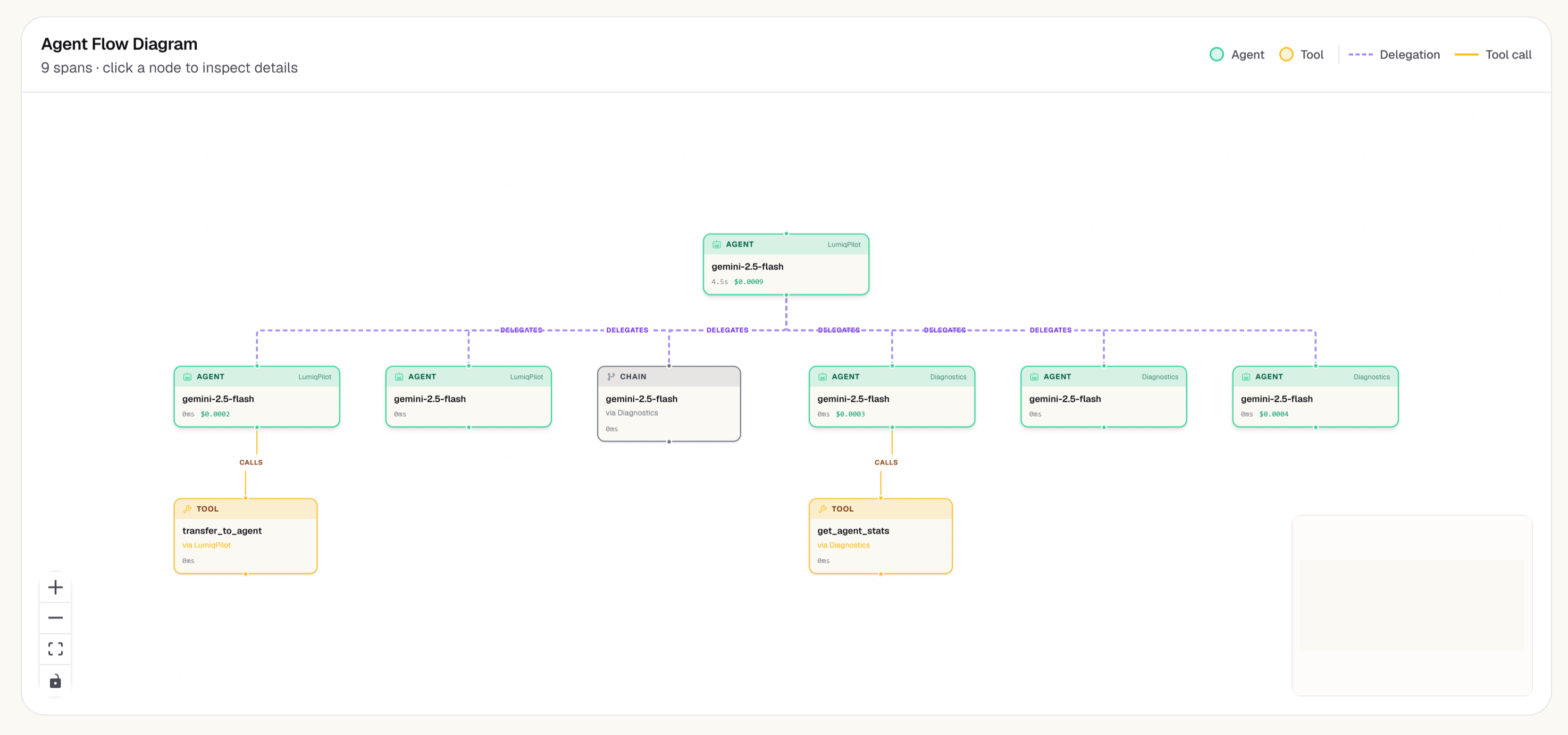
## How multi-agent traces look in the dashboard
A coordinator + specialist ADK run produces a trace like this:
```
SupportCoordinator (agent) ──────────────────────────────── 3.2s
├── gemini-2.5-pro (llm) ──────────── 1.1s
│ → tool_calls: [OrderAgent.run]
├── OrderAgent → handoff ─ 4ms
├── OrderAgent (agent) ────────────────── 1.8s
│ ├── gemini-2.5-flash (llm) ─────── 820ms
│ └── lookup_order (tool) ── 12ms
└── gemini-2.5-pro (llm) ──── 280ms finish_reason: stop
```
Each agent's total token cost is shown separately in the agent registry view, which also maps the coordinator-specialist hierarchy visually.
 ***
## Session and user context
To associate ADK traces with a user session for the Sessions dashboard view, set `sessionId` and `userId` in the wrapper options (TypeScript) or via `with_zespan_context` (Python):
```typescript theme={"theme":{"light":"github-light","dark":"one-dark-pro"}}
const { runner: tracedRunner } = instrumentADK({
coordinator,
runner,
agentName: "SupportCoordinator",
sessionId: req.session.id, // links to Sessions view
});
```
```python theme={"theme":{"light":"github-light","dark":"one-dark-pro"}}
from zespan import with_zespan_context
async def handle_request(user_id: str, session_id: str, message: str):
with with_zespan_context(user_id=user_id, session_id=session_id):
return await agent.run(message)
```
***
## Session and user context
To associate ADK traces with a user session for the Sessions dashboard view, set `sessionId` and `userId` in the wrapper options (TypeScript) or via `with_zespan_context` (Python):
```typescript theme={"theme":{"light":"github-light","dark":"one-dark-pro"}}
const { runner: tracedRunner } = instrumentADK({
coordinator,
runner,
agentName: "SupportCoordinator",
sessionId: req.session.id, // links to Sessions view
});
```
```python theme={"theme":{"light":"github-light","dark":"one-dark-pro"}}
from zespan import with_zespan_context
async def handle_request(user_id: str, session_id: str, message: str):
with with_zespan_context(user_id=user_id, session_id=session_id):
return await agent.run(message)
```